
Why speech is the biggest distraction
Volume matters less than it might seem. The deciding factor is whether we understand the words. The brain processes intelligible speech automatically, so when performing a task that requires concentration (writing, calculating, analyzing), it must "share" working memory with someone else's conversation. Based on available experiments, Finnish acoustician Valtteri Hongisto estimated that when intelligible speech is playing in the background, performance on demanding cognitive tasks drops by at least 7% on average. A laboratory study by a French team with 55 participants confirmed this relationship: the more intelligible the speech in the background, the worse people remembered information and the higher the cognitive load and discomfort they reported—at the same volume.
People in offices experience it similarly. Surveys cited by the study show that more than half of employees identified noise or colleagues' speech as their biggest distraction at work. The European Agency for Safety and Health at Work (EU-OSHA) also points out that conversations by other people can be a stressor when work requires concentration—even though their volume is far below levels that would damage hearing.
What the standards say: two numbers worth knowing
Open-plan office acoustics can be measured and planned. The international standard ISO 3382-3 introduced several indicators, two of which are useful even for laypeople:
- Distraction distance (rD) – the distance from a speaker beyond which speech is no longer easily understood. In offices with good acoustics, it is less than approximately 5 meters; in poorly designed spaces, it exceeds 11 meters. In other words: in a poorly designed office, you can "hear" colleagues from across the entire floor.
- Speech attenuation with distance (D2,S) – how many decibels the volume of speech drops for every doubling of distance. Good values are above 8 dB, poor values below 5 dB.
In 2021, researchers Hongisto and Keränen proposed an even more intelligible indicator – comfort distance, or the distance beyond which normal speech drops below 45 dB. In a collection of 179 measurements from various offices, it averaged more than 9 meters, while a good result is considered to be less than 5 meters.
The ISO 22955:2021 standard also reminds us that there is no single acoustic solution for everyone. It distinguishes types of open spaces according to activity – for example, zones where people make many phone calls or are on video calls, team spaces with frequent collaboration, spaces with minimal collaboration, or spaces where visitors are received. Each requires a different solution. The standard was confirmed as valid in 2026.

Acoustics is also a topic at ORGATEC 2026
That it is not a niche topic is also shown by this year's ORGATEC trade fair in Cologne, Germany (October 27–30, 2026), which this year places relationships between people and the transformation of the office into a place of meeting at the center. Acoustics is one of its main areas, and the German association IBA prepared a separate lecture on it about the current state of spatial acoustics and the planned regulatory changes. The organizers emphasize "room-in-a-room" solutions – acoustic boxes and booths –, screens, and cladding elements that enable focused work and confidential conversations directly in the open space.
The same signal comes from the employees themselves. A 2025 global survey by Gensler (over 16,800 respondents from 15 countries) ranked noise among the main problems of today's offices. The highest-rated workplaces are those that offer private spaces, flexibility, and the ability to control light and noise.
7 practical steps to a quieter office
1. Start with an activity map, not furniture
Find out who makes many phone calls in the office, who needs deep concentration, and where teams meet. Then separate noisy and quiet activities – calling teams do not belong next to accounting.
2. Absorb sound from the ceiling
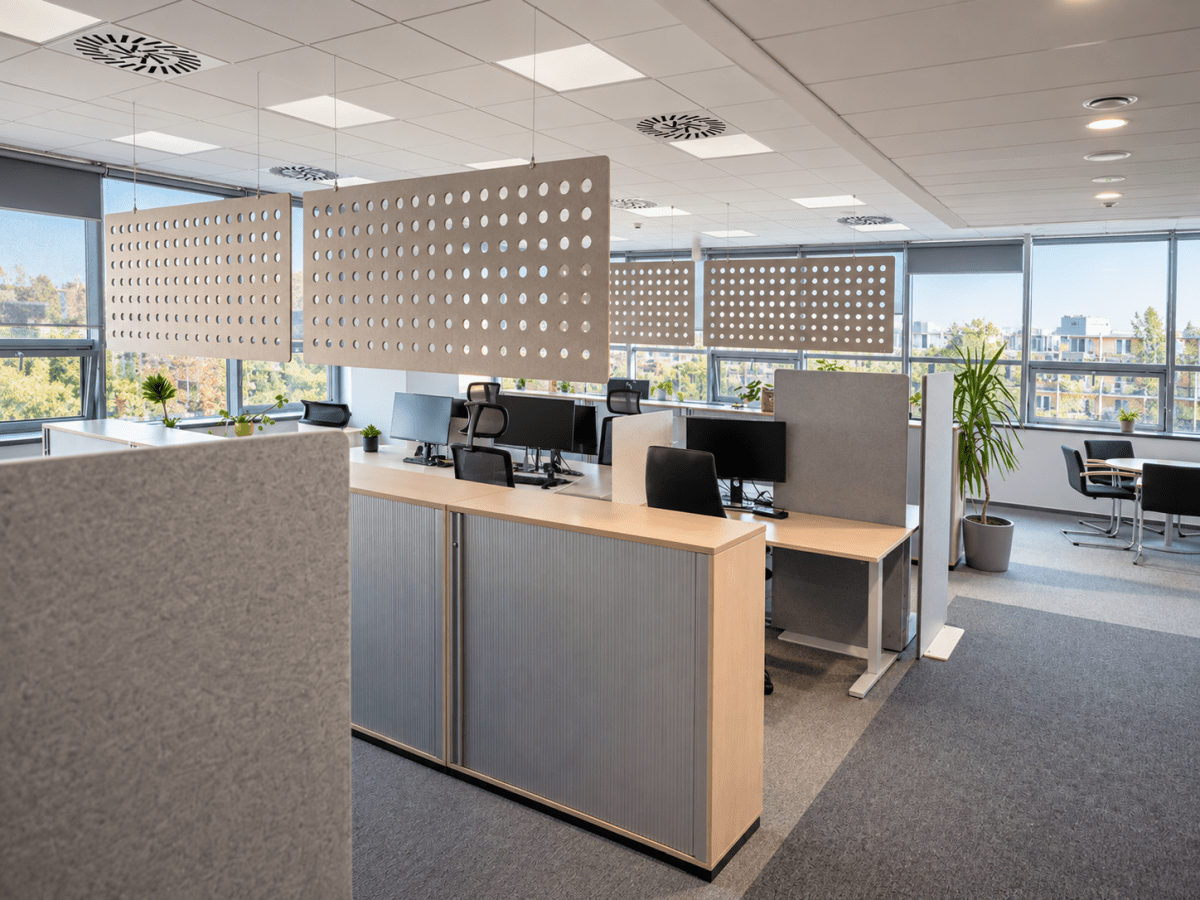
The ceiling is the largest free surface in the room. An acoustic ceiling, suspended baffles, or clouds will significantly reduce reverberation and help speech attenuate more quickly with distance.
3. Separate workstations with acoustic screens
Acoustic screens on desks or freestanding screens prevent the direct spread of sound between seated people. They work best in combination with an absorbent ceiling – screens alone have limited effect without it.
4. Use walls and furniture
Acoustic wall panels, upholstered elements, cabinets with absorbent fronts, or shelves with books and greenery break up sound reflections. Well-designed storage furniture can also separate zones.
5. Give people somewhere to go
Phone booths, small meeting rooms for 2–4 people, or quiet zones provide options. According to surveys, this is precisely what increases satisfaction and productivity the most.
6. Do not forget meeting rooms and kitchens
A video call in a meeting room with hard walls and glass sounds bad on both sides. Kitchens and lounges, on the other hand, are often sources of noise – place them outside focused work zones.
7. Measure before and after
For larger spaces, it is worth doing an acoustic measurement according to ISO 3382-3. It will show where the problem is, and after implementation, verify that the investment delivered results.

From our practice: When furnishing the open space for the Prvá stavebná sporiteľňa, we combined 253 workstations with 94 acoustic screens and custom-made acoustic panels on a floor area of approximately 1,600 m². In the KOLTEN attic office, acoustic screens and greenery between desks helped maintain an open space without constant disruption.
Conclusion: acoustics is not an addition, but part of the design
The cheapest way to address acoustics is right at the planning stage – then the layout of teams, ceiling, furniture, and retreat spaces can be coordinated. Additional noise "suppression" is more expensive and less effective. If you are planning a new office or are troubled by noise in your current one, we will design and furnish the space so that you can work and collaborate in concentration. Contact us – we will be happy to take a look at your space.
Sources
- Hongisto, V.: Office noise and work performance, CLIMA 2007 – aivc.org
- Kostallari, K. et al.: Irrelevant speech effect in open plan offices: a laboratory study (ICSV24, 2017) – arxiv.org
- Hongisto, V., Keränen, J.: Comfort Distance – A Single-Number Quantity Describing Spatial Attenuation in Open-Plan Offices, Applied Sciences 2021 – mdpi.com
- EU-OSHA: Factsheet 57 – The impact of noise at work – osha.europa.eu
- ODEON: Open-plan office acoustics (ISO 3382-3 parameters) – odeon.dk
- MathWorks: Comfort distance and distraction distance (ISO 3382-3, typical values) – mathworks.com
- ISO 22955:2021 Acoustics – Acoustic quality of open office spaces – genorma.com
- Gensler Research Institute: Global Workplace Survey 2025 – gensler.com
- ORGATEC 2026: Room acoustics: Update 2026 (IBA) – orgatec.com