

For a long time, offices were mainly concerned with whether there was enough light on the desk. The professional debate is moving on, however: it also matters how much light reaches a person's eyes, at what time of day, and whether they can adjust it. Good lighting design therefore starts with the standard, but does not end there.
What the decree and the standard say
In Slovakia, the basic requirements are set out in Decree No. 541/2007 Coll. on lighting at work. For the lighting of visual tasks, it refers to the technical standard STN EN 12464-1. Its current European edition from 2021 gives these values for ordinary office work:
- Writing, reading, computer work and meeting rooms: 500 lx, up to 1,000 lx where more demanding conditions are taken into account.
- Reception desk: 300 lx, up to 750 lx after adjustment.
- Copying and sorting documents: 300 lx, up to 500 lx after adjustment.
- Glare: a UGR index of at most 19 at desks and in meeting rooms, 22 at the reception desk.
- Colour rendering: an Ra index of at least 80.
New in the 2021 edition are so-called modifiers. A higher value comes into consideration, for example, when the work involves small details or low-contrast tasks, when mistakes are costly, when a task takes unusually long or when there is little daylight in the space. With one or two such conditions the value rises by one step, with more of them by two.
The standard is not only about the desk. For an ordinary office workplace it also specifies 150 lx on the walls and 100 lx on the ceiling. A dark ceiling and a brightly lit desk can therefore look fine in measurements and still feel cramped and unpleasant.
Why lux on the desk is not enough
Lux on a horizontal surface describes how well we can see the paper. Researchers look at the effect of light on alertness and the daily rhythm differently. In 2022, 18 experts published consensus recommendations in the journal PLOS Biology: during the day, at least 250 lx of so-called melanopic equivalent daylight illuminance should reach the eye, measured vertically at the eye level of a seated person (about 1.2 m). According to the authors, many people stay below this threshold.
The difference between the two figures is important. A desk with 500 lx does not automatically mean the eyes get enough light, because this is a different quantity measured on a different surface. When designing lighting, it therefore helps to look at the light on walls and faces too, not only on the work surface.
What we know about light and what we don't
Daylight has a strong position in studies. The Lighting Research Center followed 109 people in five American office buildings for seven days in summer and in winter. Those who received more light in the morning fell asleep faster, slept better and reported less stress and fewer depressive symptoms.
A study from the USA and South Korea of 50 workers, half of them in windowless offices, points in a similar direction. Workers with a window fell asleep about 12 to 13 minutes faster and had higher sleep efficiency. Total sleep duration, however, did not differ significantly.
One caveat belongs here: these are associations, not proof of cause. And for artificial "circadian" lighting, the evidence is weaker than advertising suggests. Experiments at the Technical University of Darmstadt from 2025, with smaller groups of young people, recorded differences in perceived sleepiness depending on the light and the time of day, while the other measures did not differ statistically. Dynamic luminaires can therefore make sense, but they are neither a substitute for a window nor a guarantee of better performance.

Six tips for your space
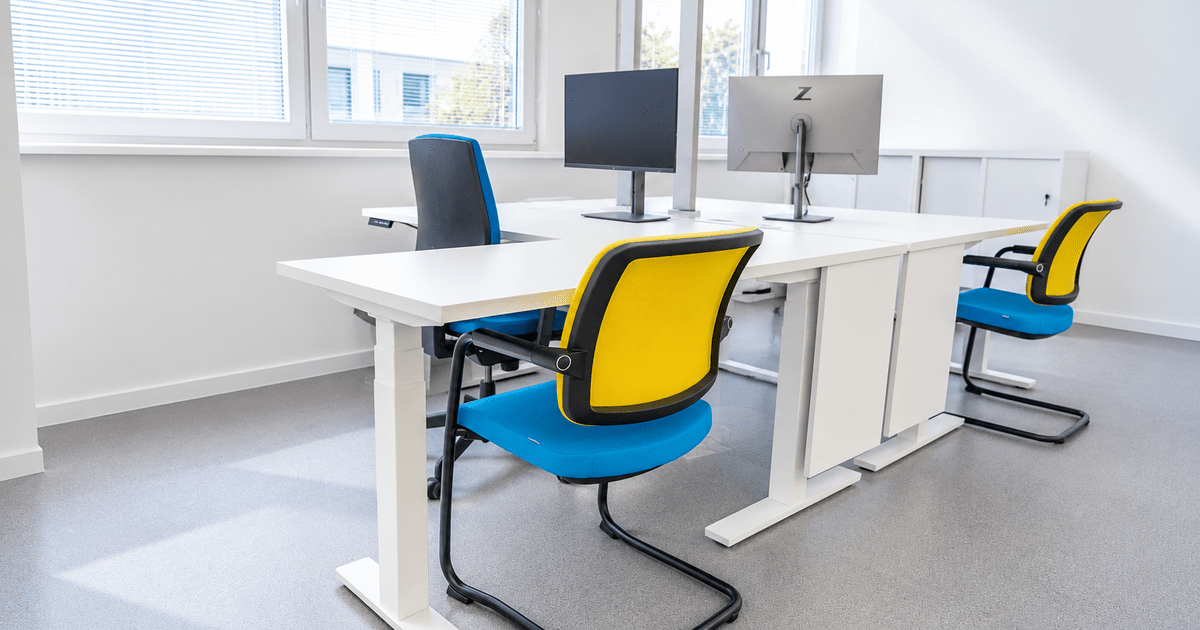
- Position desks according to the windows. It is best when daylight reaches the workplace from the side. A screen should not face a window or have its back to one, otherwise reflections or strong contrast will appear.
- Choose shading together with the furniture. The decree requires windows to be designed so that employees are not exposed to direct sunlight during long-term stays at the workplace. In a thesis from Cornell University covering 75 users of a university building, satisfaction was most strongly linked to external horizontal shading. Where it cannot be used, quality blinds or curtains help, as in our project for Alpinet.
- Layer the light. Complement general lighting with a desk lamp where people work with detail, and with an accent on a wall or shelf. A light wall optically enlarges the space and softens the contrast around the monitor.
- Give people control. In the Cornell thesis mentioned above, people who could control their luminaires were more satisfied with the amount of light at their workplace. A research review by the University of Washington states that individual adjustment also brings energy savings of about 30%.
- Plan the meeting room in scenes. A presentation needs different light from a video call or a discussion. For video calls, it pays to have enough light on faces too, not only on the table.
- Watch out for reflections. A glossy tabletop with a luminaire directly above it can create distracting veiling reflections, which according to the thesis mentioned above noticeably bother people. Matte surfaces and well-placed luminaires help.

Light can also be part of the material concept. In the KODYS director's office, a linear luminaire forms a striking element of the interior and makes the space feel softer.
Plan lighting together with the furniture
Lighting is cheapest to solve while the layout is still being drawn. Once the desks are in place, the luminaires are mounted and people are complaining about reflections, every change costs more. That is why at JC design we plan the placement of luminaires, shading and materials together with the furniture, from interior design to complete furnishing. If you are planning a move or an office renovation, get in touch and we will look at it together. Specific values for your space are then verified by a lighting calculation.
Sources
- Decree of the Ministry of Health of the Slovak Republic No. 541/2007 Coll. on details of requirements for lighting at work – Slov-Lex
- EN 12464-1: overview of values for offices – Performance in Lighting
- Standard EN 12464-1 in brief – Fagerhult
- Work-light balance: key changes to workplace lighting guidance – CIBSE Journal
- Brown et al.: Recommendations for daytime, evening, and nighttime indoor light exposure – PLOS Biology, 2022
- Office Lighting for Circadian Health and Wellbeing – Lighting Research Center / U.S. GSA
- LRC Study Finds Robust Morning Light Improves Sleep and Mood – LightNOW, 2017
- Lee, Boubekri: Impact of Daylight Exposure on Health, Well-Being and Sleep of Office Workers – Journal of Green Building
- Beck, Khanh: Effects of Spectrally Varied Lighting Conditions – Applied Sciences, 2025
- Oswald: Identifying the Relationship Between Daylighting Design, Occupant Satisfaction, and Perceived Performance – Cornell University, 2010
- Electric Lighting + Performance – University of Washington, 2021
