

Light isn't just for seeing
Besides the cells that let us see, our eyes also contain light-sensitive cells that have almost nothing to do with vision. Their job is to tell our internal clock whether it is day or night. The European Agency for Safety and Health at Work (EU-OSHA) links these so-called non-visual effects of light to the sleep–wake rhythm, alertness, body temperature and hormone production.
The problem is that in the modern world we get too little light during the day and too much in the evening. An international team of sleep and circadian rhythm experts points out that it is precisely this combination that shifts our internal clock and is associated with poorer sleep. In winter the effect is more noticeable – we spend most of the daylight hours indoors at our desks.
What studies in real offices have shown
Researchers from Northwestern University and the University of Illinois compared people who worked near windows with colleagues in windowless spaces. Those who had daylight at their workplace slept an average of 46 minutes longer and rated their vitality higher. The authors also noted that light from side windows almost disappears at a distance of roughly six to eight metres from the facade.
A more recent study from 2020 went even further. Thirty people each spent a week in two identical offices – one with conventional blinds, the other with self-tinting (electrochromic) glass that reduces glare without having to draw the blinds. In the daylit office, participants slept 37 minutes longer and scored 42% higher in decision-making tests; the difference was visible after the very first day. These are small studies, and the second was co-funded by a glass manufacturer, but the direction is consistent: more daylight during the day means better sleep and better performance.
How much light is enough? On the desk and in the eye are not the same
Light on the work surface
The European standard EN 12464-1:2021, adopted in Slovakia as STN EN 12464-1, recommends an illuminance of 500 lux for writing, reading and computer work. It gives the same value for meeting rooms, while 300 lux is enough at reception. The light should also be glare-free (UGR index of 19 or less) and render colours accurately (Ra of at least 80). The latest version of the standard also places more emphasis on lighting walls, ceilings and faces – so that people in the room can see each other well and the space doesn't feel like a dark cave with a bright desk.
Light that reaches the eyes
For our internal clock, what matters is the light that reaches our eyes, not the desk. In 2022, a group of more than a dozen scientists agreed on a recommendation that was later adopted by the International Commission on Illumination (CIE): during the day we should receive at least 250 lux of so-called melanopic equivalent daylight illuminance at eye level; in the evening – starting three hours before bedtime – no more than 10 lux; and at night as close to darkness as possible. The melanopic value simply expresses how strongly light affects the internal clock; daylight and cooler white light score higher than warm light. Scientists therefore recommend daylight first and foremost during the day, and where supplementary lighting is needed, white light with a higher proportion of blue.
In practice, this means an office can meet the standard on the desk and still deliver too little light to people's eyes. The layout of the whole space is what counts.

7 practical tips for the winter months
1. Workstations closer to the windows
The desks where people sit the longest belong in the zone along the facade. Meeting rooms, archives and phone booths can be placed deeper in the floor plan.
2. Window to the side, not behind the monitor
The U.S. OSHA recommends positioning screens at right angles to windows – when a window is behind the monitor or behind your back, it causes glare and reflections. Use blinds or curtains to cut glare, but don't keep the room dark all day.
3. Light, matt surfaces
Light-coloured walls and ceilings and matt desktops reflect light further into the room and soften harsh contrasts. Glossy surfaces, on the other hand, cause reflections.
4. General lighting plus a desk lamp
Everyone's eyesight is different. A task lamp lets people add light to their papers as needed – just angle it so it doesn't reflect in the monitor.
5. Not everything the same
According to EU-OSHA, completely uniform, monotonous lighting can also be unpleasant. Combine zones: brighter workstations, a calmer lounge and kitchenette, indirect light on the walls.
6. Light that changes throughout the day
Tunable LED luminaires can provide cooler, more intense light during the day and warmer, dimmer light towards evening. Research from real offices is still limited, but for late working hours it is a sensible step.
7. No flicker and regular maintenance
Flickering light sources disrupt concentration, and when light is insufficient we blink less, which dries out the eyes. Replace worn-out luminaires in good time and clean them regularly. And try to get outside for at least a few minutes during your lunch break – even the best office can't match daylight.

Good lighting starts with the layout
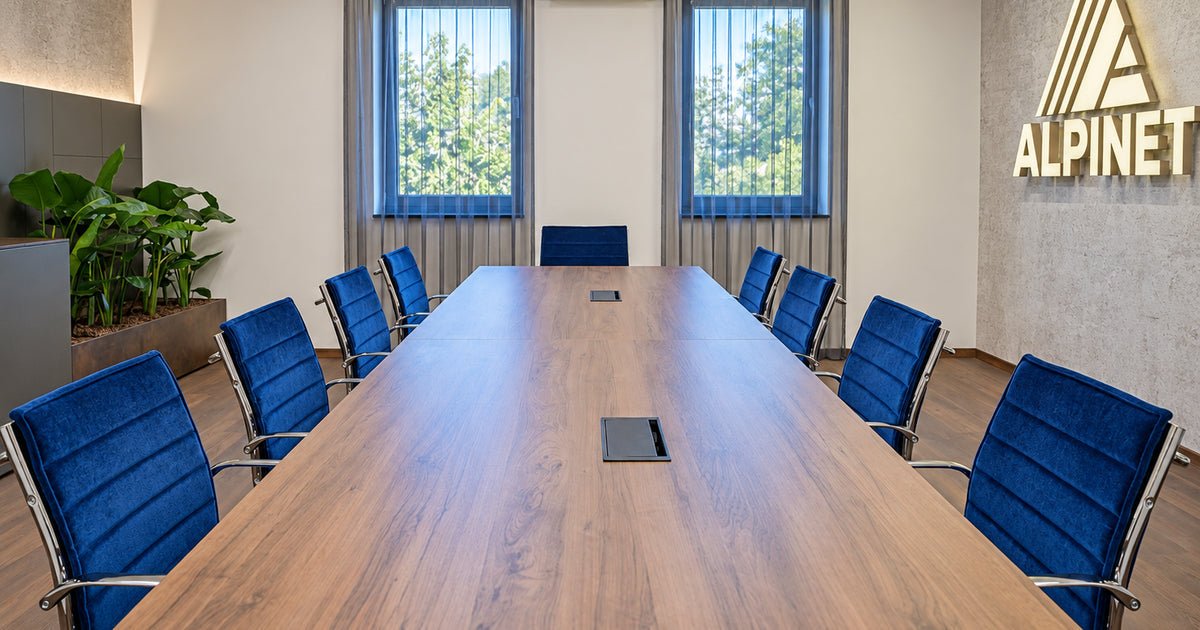
Lighting is often dealt with at the very end, once the furniture is already in place. Yet the most can be done at the start – when arranging desks relative to the windows, choosing surfaces and colours, and deciding where each luminaire will go. At JC design, we design offices as a whole: from the layout and custom-made furniture to the selection and placement of luminaires, as in our office project for Alpinet.
If you'd like your office to be an easier place to work in winter, get in touch or drop by our showroom in Bratislava. We'll be happy to walk through your space with you and design a solution that works in every season.
Sources
- Brown, T. M. et al. (2022): Recommendations for daytime, evening, and nighttime indoor light exposure to best support physiology, sleep, and wakefulness in healthy adults. PLOS Biology. doi.org/10.1371/journal.pbio.3001571
- CIE TN 015:2023 – CIE Position Statement on non-visual effects of light (summary of recommendations). files.cie.co.at
- Boubekri, M. et al. (2014): Impact of Windows and Daylight Exposure on Overall Health and Sleep Quality of Office Workers. Journal of Clinical Sleep Medicine. pmc.ncbi.nlm.nih.gov
- Northwestern University (2014): Natural light in office boosts health. news.feinberg.northwestern.edu
- Boubekri, M. et al. (2020): The Impact of Optimized Daylight and Views on the Sleep Duration and Cognitive Performance of Office Workers. IJERPH. pmc.ncbi.nlm.nih.gov
- EU-OSHA, OSHwiki: Lighting. osha.europa.eu
- STN EN 12464-1:2021 Light and lighting – Lighting of work places – Part 1: Indoor work places (preview by the Slovak Office of Standards, ÚNMS SR). normy.normoff.gov.sk; overview of requirements: Fagerhult, CIBSE Journal
- U.S. OSHA: Computer Workstations eTool – Workstation Environment. osha.gov
