

Why the space matters more than you might think
One of the largest studies on how interiors affect learning, the HEAD project at the University of Salford, followed 153 classrooms and nearly 3,800 pupils. The physical features of the classrooms explained about 16% of the differences in how quickly pupils progressed over a school year. Roughly half of that effect came from "natural" factors – daylight, temperature and air quality. Another significant share came from flexibility and the ability to adapt the room.
The study looked at children, but the principles hold for adults in corporate training too: people focus better when they can see well, hear well, breathe fresh air and change the way they work. Surveys by furniture maker Steelcase at universities point the same way – in a classroom with movable furniture and no fixed "front of the room", students rated support for creativity and motivation much higher than in a traditional room with rows of desks. These are questionnaire surveys rather than measured outcomes, but the direction matches independent research.
1. Furniture you can rearrange in minutes
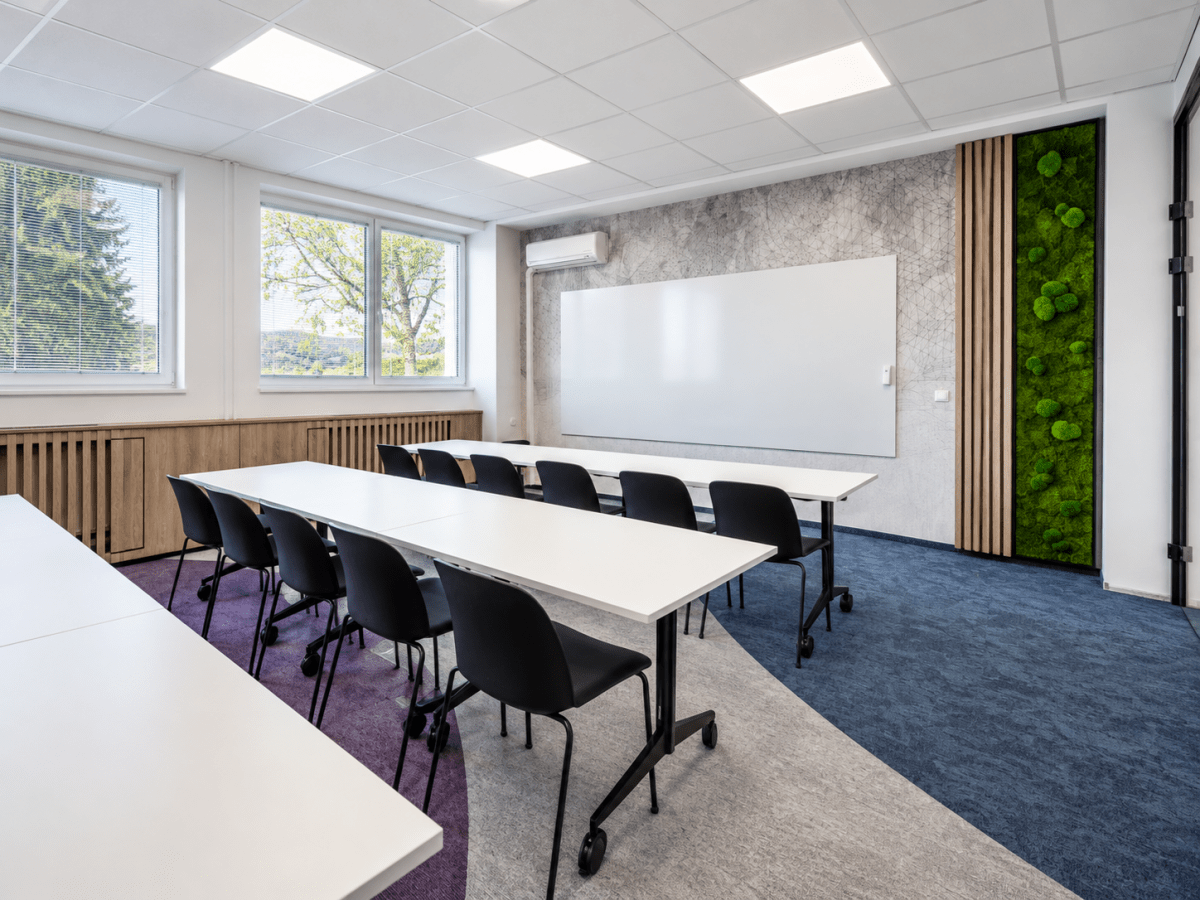
A flexible room is built on folding or mobile tables and light, stackable chairs. They let you turn a classroom layout into a U-shape for discussion, islands for group work, or open floor for activities on your feet.
- Choose tables that one person can fold and move, ideally on castors.
- Plan where folded furniture will be stored – otherwise the room will stay in one layout "forever".
- Chairs for an all-day training session must be comfortable after six hours, not just look good in photos.
In the training room we delivered for Brenntag, we used nine Pedrali Ypsilon folding tables and 18 Quinti Deep conference chairs. The same space now works for classroom-style training, meetings and workshops.

2. More places to write, no single "front"
When people split into groups, each group needs somewhere to write and present. Besides the main screen, plan for writable walls or magnetic whiteboards, or mobile boards on castors. Steelcase surveys show that students rank tools like these among the things that help them learn most.

3. Fresh air is part of the design, not a detail
Twenty people in a closed room quickly raise CO₂ levels. Harvard's COGfx research found that in lab conditions with enhanced ventilation, participants scored roughly twice as high on decision-making tests as in a conventional environment. A later global study in offices confirmed a link between CO₂, fine particulate matter and the speed of processing information.
- Size the room's capacity to its ventilation, not just to the number of chairs.
- Install a simple CO₂ sensor – the trainer can see at a glance when it's time for a break and some fresh air.
4. Lighting that adapts to presentations and note-taking
The European standard EN 12464-1:2021 recommends 500 lux for lecture rooms, and for adult-education rooms the option to raise lighting to that level. Just as important are dimming and lighting scenes: during a projection you need subdued light in the seating area, during a discussion you want well-lit faces. Wherever possible, use daylight – for example through a glass partition.
5. Acoustics: every word has to reach the back row
For classrooms, the World Health Organization recommends background noise of no more than 35 dB and a reverberation time of about 0.6 seconds. With longer reverberation, words blur together and people at the back lose comprehension. In hybrid training this matters twice as much – the microphone also picks up the room's echo.
- Carpet tiles, acoustic panels and ceilings significantly shorten reverberation.
- Watch out for large glass and bare surfaces – combine them with sound-absorbing materials.

6. Power and technology where people need them
Laptops, tablets and cameras for hybrid meetings need power in any layout. Think about floor sockets or mobile charging stations, and keep the technology simple to operate. Complex equipment that only one person in the company can switch on works against flexibility.
Quick checklist
- Can the room be rearranged in 10 minutes without help from facilities?
- Does every group have somewhere to write and present?
- Do we know the CO₂ level after an hour of training?
- Can the lights be dimmed and adjusted to the activity?
- Can the trainer be understood in the back row and over the microphone?
- Is a power outlet within reach of every seat?
Conclusion
A good training room isn't about the number of chairs, but about how quickly it adapts to what is happening in it. Add fresh air, adjustable lighting and good acoustics to flexible furniture, and people will focus better and take more away from their training.
Planning a training or meeting room? See how we designed and delivered the training room for Brenntag, or get in touch. JC design will help you with the design, furniture selection and complete interior fit-out.
Sources
- Barrett, P. et al.: Clever Classrooms – Summary report of the HEAD project, University of Salford, 2015 – salford-repository.worktribe.com
- Barrett, P.: article on the findings of the HEAD study (WorldDidac) – worlddidac.org
- Harvard T.H. Chan School of Public Health: The COGfx Study – healthybuildings.hsph.harvard.edu
- Building Design + Construction: New Harvard study expands research on indoor air quality and occupant performance – bdcnetwork.com
- Steelcase: Active Learning Classrooms (Oregon Institute of Technology research) – steelcase.com
- Campus Technology: Report – Classroom Design Improves Student Engagement – campustechnology.com
- ArchDaily: Poorly Designed Acoustics in Schools Affect Learning Efficiency and Well-Being – archdaily.com
- National Academies: Review and Assessment of the Health and Productivity Benefits of Green Schools (Acoustics chapter) – nationalacademies.org
- Glamox: Auditoriums and lecture halls – EN 12464-1:2021 requirements – glamox.com
- Trilux: Lighting of educational facilities – Adult education – trilux.com
