

A sitting ball promises a more active back and less rigid sitting. Research shows, however, that it doesn't hold up as an all-day replacement for an office chair – though it works well as an add-on for shorter stretches of the day. We looked at what studies say about exercise balls in the office, how to choose the right size and how to use one so that it genuinely helps your back.
Why people reach for a sitting ball
The idea is simple: a ball is unstable, so the body has to make constant small adjustments to stay balanced. The expectation is that this engages the deep core muscles, makes us sit more upright and move more. That's why exercise balls turn up in home offices, creative teams and coworking spaces – and they feel more playful than an ordinary chair.
Movement during sedentary work really does matter. The World Health Organization (WHO) 2020 guidelines urge adults to limit the time they spend sitting and replace it with any activity, even light activity. So the question isn't whether to move, but whether a ball is the right tool for it.
What studies say about sitting on a ball
Research findings are fairly consistent – and may surprise many people:
- Core muscles work much as they do on a chair. In a study by Gregory and colleagues (2006), 14 adults sat for one hour on a ball and one hour on an office chair. Lumbar spine posture and the activity of most trunk muscles were almost identical – but on the ball, participants reported more discomfort in the lower back and buttocks.
- No measurable “strengthening” effect. McGill and colleagues (2006) compared sitting on a ball with sitting on a backless stool. Activation of 14 trunk muscles, spinal load and spinal stability did not differ. The ball's larger contact area with the body may explain why sitting on it for long periods is less comfortable.
- More movement, but also more load. Kingma and van Dieën (2009) found that during an hour of typing on a ball, the trunk moved about a third more, but the lower-back muscles were more active and the spine “compressed” more over the sitting period. The authors concluded that the extra movement does not outweigh these drawbacks.
- The extra calories are negligible. According to Beers et al. (2008), sitting on a ball during clerical work burns only about 4 kcal per hour more than sitting on a chair – the same as standing.
Researchers at the University of Waterloo and ergonomists at Cornell University therefore agree: don't replace a good office chair with a ball. A ball has no backrest or lumbar support, and when used all day it tends to tire you out.

When a sitting ball makes sense in the office
A ball has its place as an add-on to an ergonomic workstation, not as its foundation. It works well:
- for shorter periods – for example 20–30 minutes while reading emails, on a phone call or during a brainstorm, then back to the chair or to a standing desk,
- in shared and informal zones – in meeting rooms for creative teams, break-out areas or coworking spaces where people rotate,
- as a prompt to change position – the Canadian agency CCOHS recommends changing position often and not sitting without a break for more than about an hour. A ball is one way to make that change.
How to choose the right size of sitting ball
When you sit on the ball, your hips should be level with or slightly higher than your knees, and the angle at the hips and knees should be about 90° or a little more. Your feet should rest flat on the floor. As a rough guide:
| Ball diameter | Body height (approx.) |
|---|---|
| 45 cm | up to approx. 152 cm |
| 55 cm | approx. 155–173 cm |
| 65 cm | approx. 175–188 cm |
| 75 cm | approx. 190–200 cm |
Different sources give slightly different ranges, so treat the table as a guide. Leg length and desk height are what really count – people with longer legs often need a bigger ball. You can also fine-tune the height by how much you inflate it.
Safety and practical tips
- Don't inflate the ball beyond its recommended diameter. Duke University's safety office warns that an over-inflated ball can burst and cause a fall.
- Don't reach far while seated. Stretching for a phone or a binder increases the risk of slipping – keep things within reach.
- Check the pressure regularly. A ball gradually softens, and the seat height changes with it.
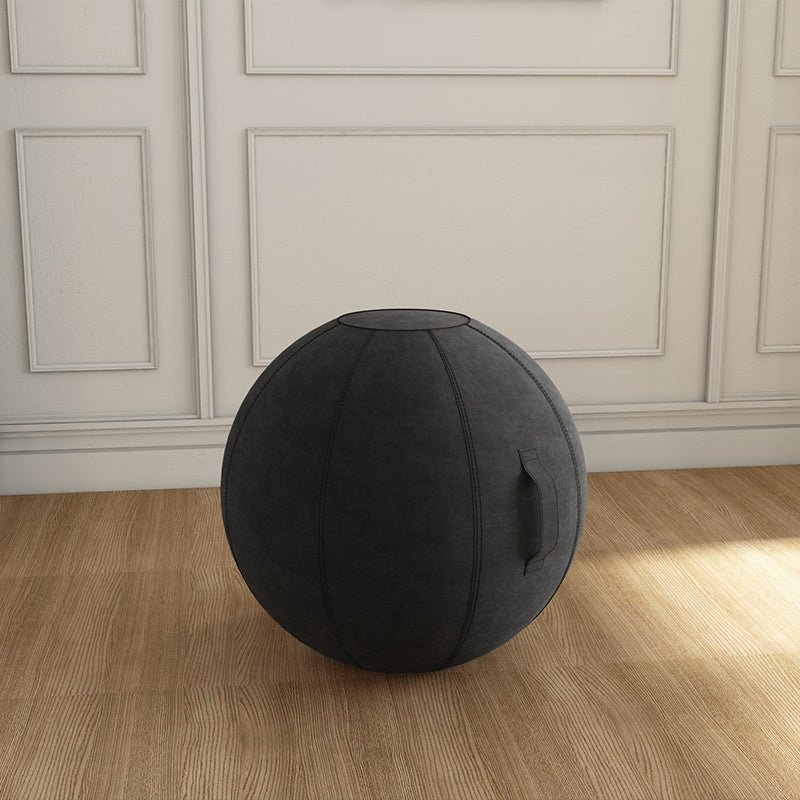
- Choose a cover. A fabric cover, like the one on the ErgoBall sitting ball (65 cm diameter, cotton and linen cover), looks like a piece of furniture in an interior, is nicer to the touch and, thanks to its handle, is easy to carry.
- Mix it up. The best results come from alternating: an ergonomic chair, standing work at a height-adjustable desk and, now and then, a ball or a short walk.

The sitting ball as part of an ergonomic workstation
When we design offices at JC design, our aim is for the space to encourage movement naturally – not with a single “miracle” item, but with a combination of solutions. Every desk deserves a quality ergonomic chair, ideally the option to work standing up, plus accessories for changing position. You'll find the full range in our Ergonomics collection.
Frequently asked questions
Is a sitting ball good for your back?
As an occasional change of position, yes; for sitting all day, no. Studies have not confirmed stronger core muscle activation or lower spinal load, and people experience lower-back discomfort on a ball more often.
How long can I sit on a ball each day?
Studies don't set a fixed figure. It makes sense to start with short periods (e.g. 15–30 minutes) and alternate them with sitting on a chair and standing.
What size ball do I need?
As a guide, 55 cm for a height of about 155–173 cm and 65 cm for 175–188 cm. Check that your hips are slightly above your knees and your feet are flat on the floor.
Can a ball replace an office chair?
Experts from universities and occupational safety offices advise against it – a ball has no backrest or lumbar support. It's an add-on, not a replacement.
Conclusion
A sitting ball isn't a miracle, but it can be a welcome change of pace during the working day – as long as you use it in moderation and have a good chair to hand. Planning an office where people can move naturally? Get in touch – we'll design workstations that combine ergonomics with great design.
Sources
- University of Waterloo, CRE-MSD – The use of stability balls in the workplace in place of the standard office chair: uwaterloo.ca
- Cornell University Ergonomics Web – Ball Chairs: ergo.human.cornell.edu
- Kingma & van Dieën (2009), Applied Ergonomics – Static and dynamic postural loadings during computer work in females: epistemonikos.org
- Beers et al. (2008), European Journal of Applied Physiology – Increasing passive energy expenditure during clerical work: link.springer.com
- Duke University OESO – Position Statement on Use of Exercise Balls: safety.duke.edu
- Spine-health – Choosing the Right Exercise Ball: spine-health.com
- Bull et al. (2020), WHO guidelines on physical activity and sedentary behaviour, BJSM: pmc.ncbi.nlm.nih.gov
- CCOHS – Working in a Sitting Position: ccohs.ca
